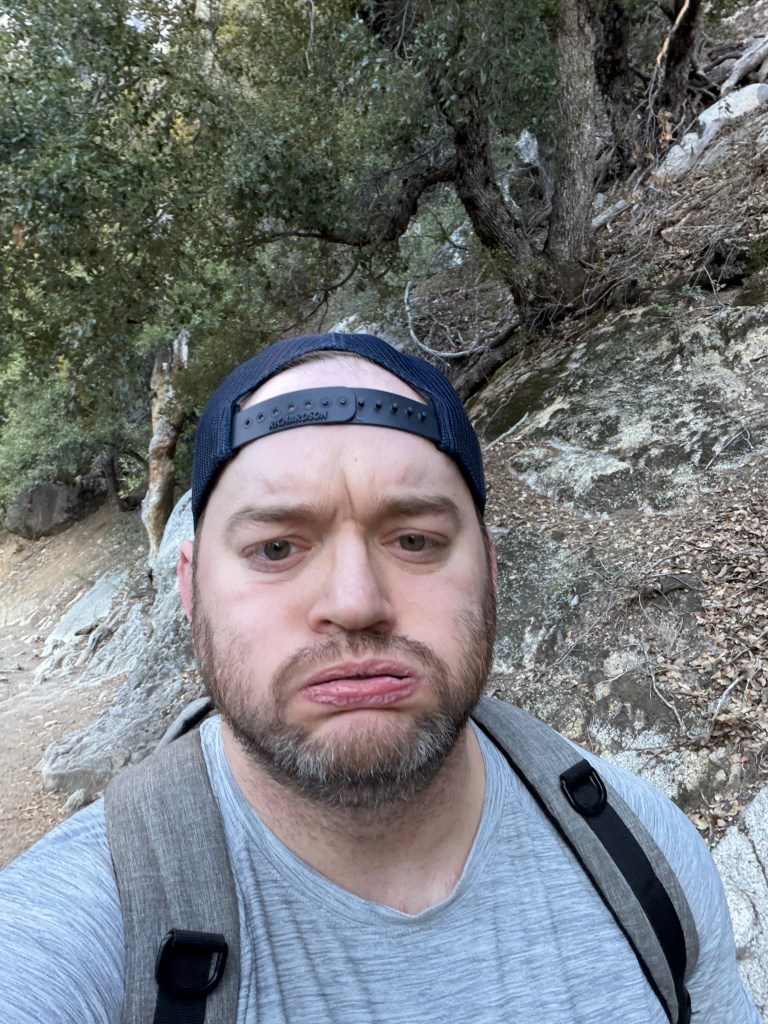
In my travels across the country to various school districts I always try to get to know the community a little bit. Most of the time this is limited to getting recommendations on local restaurants, but every once in a great while, I get the opportunity to actually explore some of the area in a grander sense: catch a ball game, check out a museum, or take in some of the natural surroundings that are different than what I see at home. It was on a recent trip to Fresno, CA that I found myself with the opportunity to go hiking at Yosemite National Park.
I was so excited! As a kid, my family vacations were centered around visiting many National Parks, but I had never been to Yosemite. I caught a bus at 5am to drive me a few hours to the park where I planned to stay until I could catch a bus back twelve hours later.
My original plan was to just stay on the Yosemite Valley Loop Trail. It was pretty much flat and served as a path between many other trailheads, but I would be able to view many of the famous landmarks from that path. Plus, there was a shuttle bus that I could hop on to speed up my journey if I wanted to skip to the next landmark.
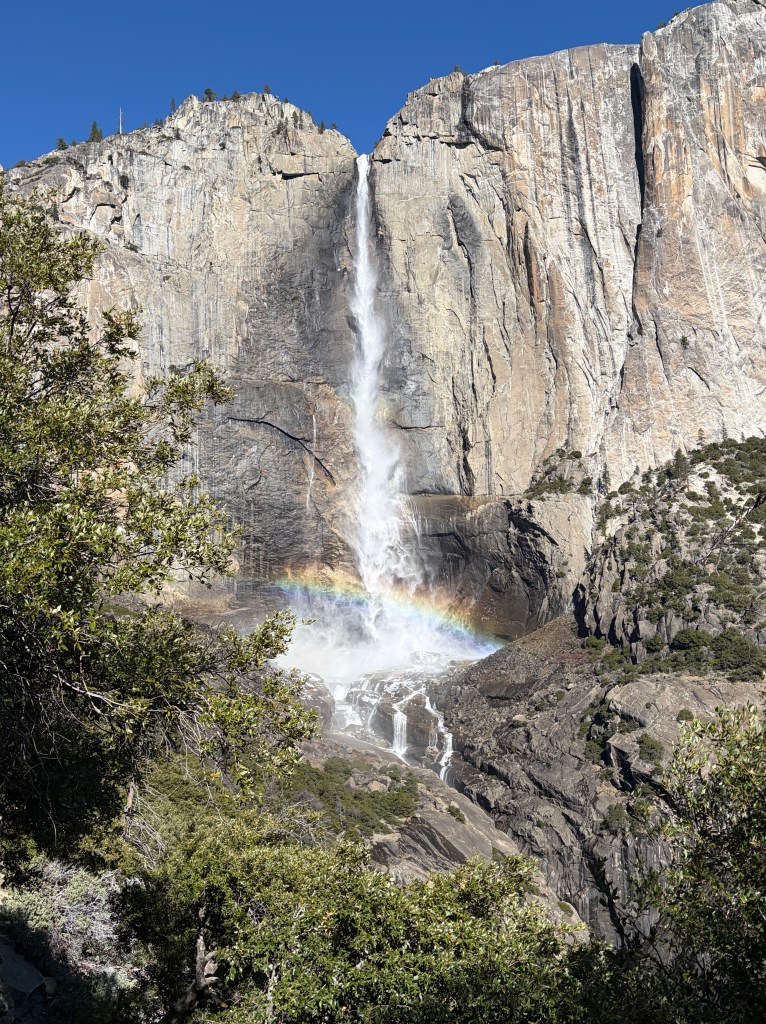
On the bus ride in, I was in awe of the sheer size of the landscape. At moments it didn’t look real. As the sun rose to splash light on the trees and rocks I caught a glimpse of a single, majestic waterfall. I decided that would be where I would start my trek around the loop. Once I hopped off the bus, I headed in the direction for the falls but then I saw a sign “Yosemite Falls – 3.5.” It was a trailhead marker that deviated from my planned course on the loop trail and instead was a trail to the top of the waterfall I had seen from the bus. I paused for a moment and made the decision to change course. 3.5 miles didn’t seem too bad and I figured I could do that trail, get back down in time for lunch and still have time to see many other things along the loop.
The Tortuous Trail to the Top
This may not have been my most egregious underestimation ever made, but it is certainly in the running. The trail consisted of natural rocks in configurations made to resemble stairs that switched back and forth every 50-100 feet as you constantly climbed upward. While the sign indicated the trail was 3.5 miles in length, it failed to also mention that I would be climbing roughly 3,300 feet in elevation as well. My huffing and puffing soon rivaled that of the big bad wolf and might have stood a chance of blowing down the brick house, much to the dismay of the three little pigs. Luckily, I had gotten an early start so I was pretty much alone on the trail and could stop and rest as much as I needed.
After 3 hours, I made it to the top to the overlook of the waterfall. I spent a solid 20 minutes sitting there enjoying the view, cosplaying a serious hiker as I ate my Lemon Cake Quest Bar and chicken jerky stick. Of my 48oz of water I had brought, I had only about 1/3 of the bottle remaining. I decided to save the rest for the trip down, which I told myself would be much easier. While the way down did go faster (2 hours), it was still hard work. My legs began to cramp in various places, I was running out of water, and now the trail was full of chatty hikers on their way up to get a glimpse from the top like I had. Many wanted to stop and ask about trail conditions at the top, seek affirmation that the view was worth the effort, or have an excuse to stand even footed for a moment to take a break from the neverending stone Stairmaster of a trail. During these conversations, I tried my best to keep the tremoring in my legs to a minimum, which was near impossible at this point.
I lost the trail twice on the way down, but luckily there were enough folks headed up I realized it pretty quickly in both instances and found my way back to the path. By the time I made it down, I was no longer interested in hiking any more that day. I grabbed some lunch and tried to let me legs, lungs, and heart rest. At the end of the day I checked my Apple Watch which indicated I had burned over 2400 calories, exercised for almost 6 hours, took over 25,000 steps for a distance of 9.5 miles, and climbed 251 flights of stairs. Many of these were personal records, but what I was most proud of was that I could have turned around about halfway through the trail having gotten a really nice view of the waterfall by then. But I didn’t.
Defining the Path of Progress
The hike to the top of Yosemite Falls was difficult for me, and honestly, had I known how hard it was going to be, I probably would have passed that day. However, while my lack of being in shape played a major role in the difficulty of the hike, it was also difficult because the path was completely unknown to me. I didn’t know how high I’d have to climb. I didn’t know how much longer it would take me to get to the top. I didn’t have a good way to strategically use my energy and resources to set myself up for success.
This is what instruction without a learning progression can feel like. It’s possible to make it all the way to the standard, but without a clearly charted path, it’s a lot more difficult for both the teacher and the student. Learning progressions are “descriptions of the successively more sophisticated ways learners must think and act while they are developing knowledge and skills over time” (Erkens, Schimmer, & Dimich, 2017, p.85). When a learning progression is in place, the aspects of both unit planning and instructional design, such as pacing, assessment, strategies, and interventions/extension. It becomes the skeleton upon which the rest of the unit of instruction can be fleshed out.
Pacing: A team that has created a clear learning progression for a standard can appropriately pace their instruction to match the sequence of steps toward mastery of the standard. Some steps may take longer than others to learn, so the pacing may not have an even cadence throughout the entire progression. Just like a hiking trail, some sections might be more complex than others and take a larger investment of time and energy. A learning progression helps to anticipate this need and allow for teams to account for it in their pacing.
Strategies: Rather than have a general approach to teaching a standard, a learning progression affords teachers to specifically plan for incremental progress. Doing so makes their planning more focused on student learning instead of simply covering standards. Specific strategies can be intentionally matched with each step of the learning progression to support student success along the way. If I had a better understanding of the trail I was hiking, I would have been able to not only allocate my pacing more appropriately, but I would have been able to approach each section of the trail more strategically. I could adjust my speed, rationing of water, and timed out my rest and stretch breaks at key moments. With a learning progression, teachers can strategize in a more anticipated manner, rather than having to wait for an end of unit assessment and reactively employ strategies to address missing skills and concepts.
Assessment: Learning progressions also help to schedule formative assessments at strategic times within the unit of instruction. By using a learning progression in this way, the team “intentionally times its gathering of data to occur at critical junctures in student learning to check in on progress, provide feedback, and adjust” (Williams, 2026, p.61). Hikers who were headed on their way up were able to gather additional information from me to help them adjust their approach to the top. Based on the information they gained, they could make better informed decisions around their speed, rationing of water, and general approach to the terrain.
Intervention/Extension: When formative assessments are designed to align with specific steps on a learning progression, planning for intervention or extension becomes more efficient. For students who are not yet at mastery, a team can look at where each student is at on the progression and design the intervention around getting to the next step on the progression. This connects to one of the most difficult aspects of my hike. I would have greatly benefited from intermittent goals to work toward during my trek to the top. Knowing that this steep section of the trail ends after the next switchback gives me a more concrete success criteria that seems attainable than looking at my watch and seeing I’ve only completed 1 mile so far. The goal is still to get to the top (mastery of the standard) but intervening specifically on skills or concepts in the progression helps to make incremental progress more defined and doable. Extensions can be approached similarly. For students who are already showing mastery, what is the next clearly defined step for their learning? A learning progression can expand beyond the grade level standard to bring consistency to how the team approaches their extension as well. (I don’t have an analogy from my hike for extension since I was clearly in need of some targeted intervention!)
In my work with teacher teams I have come to believe that creating a learning progression as a coherent sequence of skills and concepts that leads to mastery of a standard is arguably the most critical part of any unit plan. Not only do they provide the structure to bring alignment and coherence to the other aspects of unit planning, the instructional planning can become more efficient over time as the team identifies quality assessments, impactful strategies, and successful interventions and extensions to use with each step. Trying to engage in other aspects of unit planning or instructional design without first charting a path for progress runs the risk of the journey being more difficult than needed, or perhaps, even diverging from the intended trail.
My Inquiry
As the name of this blog implies, I will end each blog with the question(s) bouncing around in my head. These are the questions I’m still asking:
- Are learning progressions as important as I feel like they are? If they aren’t, how are teams able to engage in their unit planning and instructional planning efficiently and sustainably?
- What seems to be the biggest obstacle in bringing learning progressions to the forefront of collaborative team discussions?
- What are there other benefits to creating and using learning progressions that I haven’t discussed?
Erkens, C., Schimmer, T., Dimich, N. (2017). Essential assessment: Six tenets for bringing hope, efficacy, and achievement in the classroom. Solution Tree Press.
Williams, J. (2026). Shared data, shared decisions: A student-centered framework for a healthy data culture. Solution Tree Press.
 The Educated Inquiry
Leave a comment