
If you are wondering where April’s blog post went, it never materialized. We welcomed our second daughter in March. She’s cute as a button and Mom has recovered well. However, we are still figuring out our playbook as we shift our primary defensive playbook to man-to-man with two kiddos to corral, one of whom is in the throes of potty training. It’s been controlled (mostly) chaos, so thanks for your understanding of missing a month.
The good news is that baseball season is underway and watching my Chicago Cubs has always been a nice way to relax. As a youngster, I remember sitting with my dad in our living room chair after church on Sunday afternoons with WGN airing the game. Both of us were usually napping well before the 7th inning stretch. And while the Cubs have not always been a great example of championship caliber baseball, I have been their loyal fan since I can remember. I also just love the game.
Maybe it’s the history. Maybe it’s the metrics. Maybe it’s the fact that it’s a true team sport even though play is executed through individual performances. I really can’t say. I just know I enjoy watching it and playing it. As I’ve written before, I think and process primarily through metaphors and analogies. Well, this time I’ve found multiple overlaps between baseball and education. Instead of processing through an extended metaphor, I found myself thinking about different aspects of both baseball and education through some different lenses.
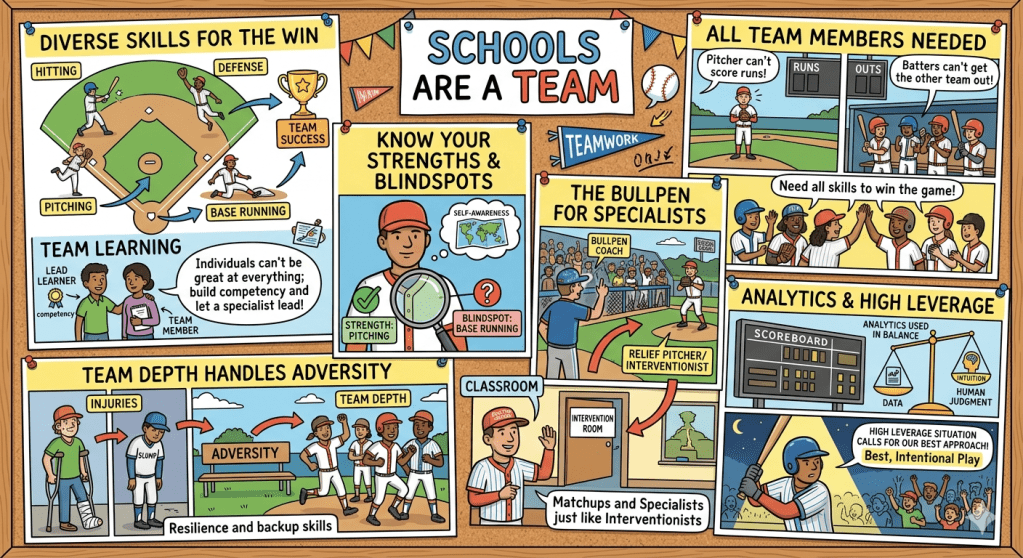
Need Multiple Skillsets to Win Consistently
The best teams in baseball are the ones who are able to win in multiple ways. Sometimes they are able to dominate the other team with their pitching. Other times, their hitters seem unable to stay off the basepaths forming a constant conga line to home plate. There are even games that are so tight that the defense needs to play almost perfectly while the offense finds ways to manufacture a rare run or two through strategic hitting. The point is a team that focuses only on one skillset will have a much harder time winning consistently. More often than not, these varied skillsets exist across multiple players. While there are superstars who are good, if not great, at many baseball skills, a pitcher still can’t score any runs for the team just like a batter can’t strike any of the opposing batters out.
As educators, our teams function similarly in that we need all skillsets to consistently impact students in a positive way. We also can’t rely on individuals to be good at everything. That is not a recipe for sustained success. A better approach would be to view a teacher team like a baseball team where all players are reasonably competent at all baseball skills but there are individuals who are more proficient in certain areas where they can take the lead on aspects of work that match their skillset. To be effective, teams need to understand their assets and blindspots.
Team Depth Helps Overcome the Adversity in a Long Season
It’s a long season folks. Major leaguers play 162 games over the course of six months. There’s a lot that can occur over that timespan: winning streaks, losing streaks, injuries, slumps, etc. The best teams are built to weather the adversity a long season all but guarantees. The Chicago Cubs were praised for the depth on their team at the start of the season. This proved to be a very necessary aspect of their team when not one, not two, but three of their five starting pitchers all found themselves on the injured list. Despite these injuries to key pieces of their lineup, the Cubs still managed to crack off two separate winning streaks of 10 games within their first 40 games. (We will ignore the fact that at the time of writing this blog they have lost 6 games in a row.)
It’s an even long school year ya’ll! Students attend 180 days over the course of ten months. There’s a lot that can occur over that timespan. The schools have a collaborative culture that provides the “depth” needed to withstand all the ups and downs throughout the year. Whether it’s student behaviors, adult behaviors, teachers on leave, student academic needs, or other organizational changes, having a strong collaborative culture develops collective teacher efficacy to weather adversity.
Use Data in Balance with Intuition and Situational Knowledge
If you’ve seen the movie Moneyball with Brad Pitt and Jonah Hill, you’ve seen a glimpse of how analytics are used in baseball. As I mentioned before, baseball is a true team sport but it’s executed through individual performances. This means that there are many different ways to measure individual performance through statistics. It’s relatively easy to compare an individual player’s performance to other players within the current season, compare an individual player’s performance to their historic trends, and even comparing current players to player performance that occurred a century ago. However, with all this information available, analytics is used in concert with human scouting and situational context all playing a role in decision-making.
In education, we’ve never had more data available to us. You may be familiar with the concept of DRIP (Data Rich; Information Poor). Data is only as valuable as the inferences we make and the actions we take based on its information. We want to avoid using any one data set to inform our decisions because any given data set only tells part of a student’s data story. We need to base our decisions on as complete of a picture as possible, which means we need to bring the qualitative data (observations, anecdotal evidence, situational context, etc.) into the conversation. It’s a balance.
High Leverage Situations Call For Our Best and Most Intentional Approaches
In baseball, each team gets 27 outs to try to win the game. Your goal is to score as many runs as possible before you team gets out 27 times. Conversely, you want to get your opponent out 27 times as quickly as possible to minimize the runs they score. Viewing the game like this, you can identify key parts of the game that would be considered “high leverage.” Bases empty in the 2nd inning with the game still tied 0-0 is not a very high leverage situation. However, bases loaded with the tying run on first base and two outs in the top of the 9th inning is very high leverage. Teams often try to use their best pitchers out of the bullpen during these high leverage moments, especially in the playoffs. Rather than always saving them for the end of the game, a manager may pull their starter early to get a key matchup between their bullpen pitcher and the upcoming hitters in a high leverage situation. Because remember, there’s only 27 outs to either win or lose the game.
In education, each student only has one school year to master their grade level’s standards. We can all agree that some of these standards are more essential than others. While we still instruct all standards, a standard that is deemed essential requires the team’s commitment to not just instruct it, but to measure it commonly and provide additional time and support to students who still have not demonstrated mastery of it. It is this commitment that makes it impossible for every standard to be deemed essential since we wouldn’t be able to intervene on every single standard. Your essential standards are your high leverage moments and require us to intentionally match our best strategies and approaches to instruction. After all, there’s only one school year to either master the grade level standards or not.
My Inquiry
As the name of this blog implies, I will end each post with the question(s) bouncing around in my head. These are the questions I’m still asking:
- While I typically stay away from sports analogies, I couldn’t help but see the connections between baseball and education. What other connections am I missing? What about with other sports?
- It’s possible I’ve oversimplified or missed nuances within either baseball or education that might make these comparisons inaccurate. Have I missed something here or do these make sense?